AI governance & council frameworks
Moving an agency from AI experimentation to operational capability — with guardrails, a council with a system of record, and a training series that teaches delegation, not prompting.
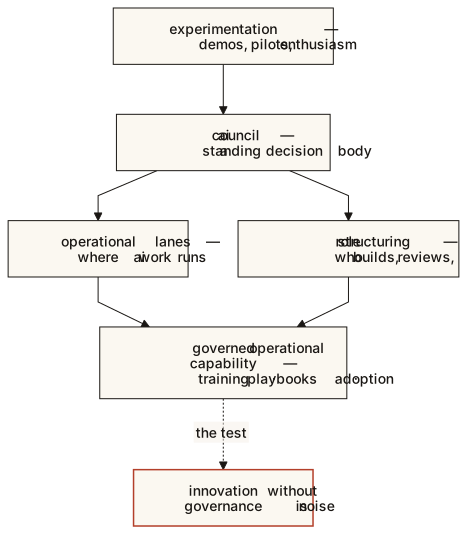
AI governance model and roadmap for Team One Digital: council frameworks, operational implementation lanes, AI role-structuring proposals, and training delivered to the entire 400-person agency — plus the playbooks, prompting guides, and workflow blueprints behind it. 150–200 staff are in active adoption, and the questions have shifted from “how do I log in” to advanced use-case problem-solving — the signal that fluency, not just access, is taking hold. The goal is unglamorous on purpose: make AI a governed operational capability rather than a rotating demo.
Two 2026 additions. The council now has a system of record — the program hub (see compass), where the roadmap, automations, intake, and usage telemetry live, and where the ownership gap is the headline by design. And the agency's training series moved from prompting to delegating: season one was twelve weekly prompting sessions; season two is eight biweekly sessions on one spine revisited every time — Frame → Feed → Equip → Direct → Verify → Govern — covering context, tools and MCP, building with AI safely (including the sandbox-only zone rule that is also the written engineering standard), judgment in the loop, governed AI, and a multi-agent capstone, each split into ownable segments so council members self-select what they teach. The hub was chosen as its headline demo.
Two sessions from season two, as taught. “Judgment in the Loop” was built on a research pack of roughly ninety-five sourced searches and a seeded-errors demo — a memo with mistakes planted in it, checked live — and two lines meant to outlast the slides: plausible is its job, correct is yours, and you sign the work, not the model. Its leave-behind is a tool, not a deck (see claim check). “Building with AI” was a low-copy deck around a pick-your-level ladder — explore, prototype, build, ship — with four colleagues' prototypes shown rebuilt as production apps, so the ladder had real rungs.
Full case study in progress — artifacts pending clearance or writing time. The insight below is already earned.
Innovation without governance is noise.
the insight